Circular supply chains
This is a summary of the paper ‘Mapping Supply Systems in Circular Settings: A Proposal for a New Methodology’ by Zerbino et al. (2025).
Link to full paper: https://doi.org/10.1016/j.cie.2025.110891.
Implementing a circular solution, such as recycling a material or reusing a product, affects more than the company that produces or receives it. Waste must be collected, checked, processed, and transported. New organisations may become involved. Existing companies may need to change their activities. These dynamics can reduce the need for virgin raw materials, but also requiring additional energy, water or transport and generating new emissions.
Understanding the overall transformative effect of a circular solution requires looking at the entire supply chain. Commonly used diagrams often leave out some of these elements or become difficult to read when many flows and organisations are involved.
What MACSS does
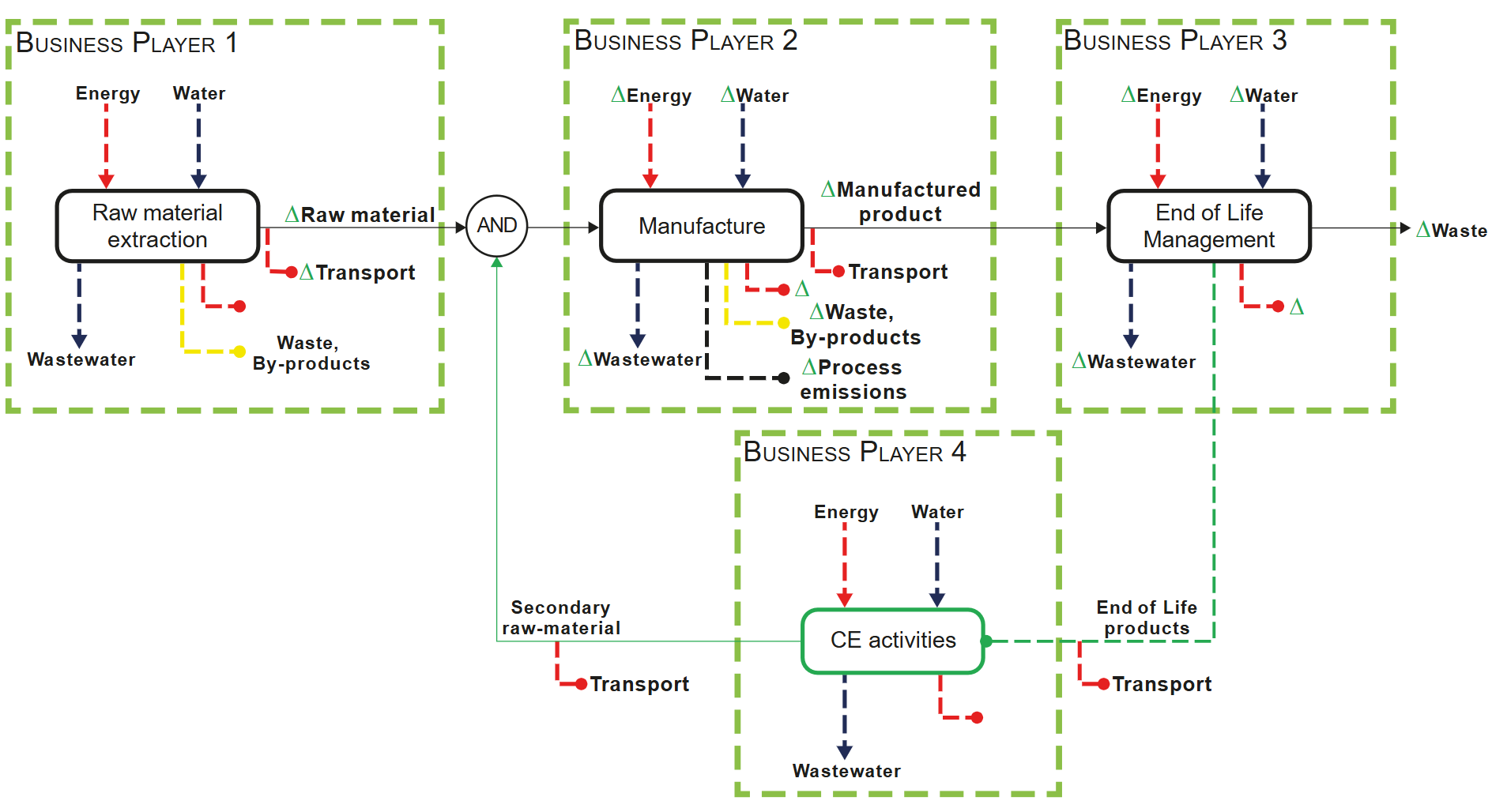
Our study introduces MACSS, which stands for MApping Circular Supply Systems. MACSS is a mapping methodology developed specifically for circular supply chains. Using a common set of symbols and colours, a MACSS map shows which organisations are involved, what activities they perform, and how materials, energy, water and emissions move between them.
The methodology can represent both the current supply chain and a possible circular configuration. Comparing the two maps makes the consequences of a circular practice visible. Users can see where waste becomes a resource, which activities and connections must be added, and where material use or emissions may change.
Practical value for different users
Companies can use MACSS to understand how a circular practice would affect their operations and relationships with suppliers, customers and recovery partners. The map helps identify the changes that must be organised before implementation, including new processing steps, responsibilities, and transport routes.
Researchers and environmental analysts can use MACSS to graphically identify the relevant activities and flows and related changes induced by circular solutions, reducing the risk that important effects are overlooked during subsequent assessments, such as Material Flow Analysis and Life Cycle Assessment. The same overview could be useful to investigate whether a proposed circular solution simply moves environmental pressures or operational burdens from one part of the supply chain to another.
Application to flat glass
MACSS was tested into the European flat glass industry, focusing on the recovery of glass offcuts for use in new production. The resulting maps show how glass waste returns to the production process, which additional activities and organisations are required, and where the use of raw materials, energy and transport changes. This application demonstrated how MACSS can turn a complex circular economy proposal into a clear picture of what would change, where it would change and what should be assessed.