Focus Areas
Linear economy x Circular Economy
Circular economy strategies and the 10Rs
Our society basically runs on a linear economy. Fancy term simple idea: we take, we make, we use, and at the end, we throw it away, and this includes buildings. Even though we have centuries-old constructions still standing strong, most modern buildings today are designed with an estimated lifespan of 50–60 years. This leads to millions of tonnes of waste every year from the construction sector alone. Most of it ends up in landfills or is incinerated, leading to greenhouse gas emissions, environmental pollution as well as resource depletion.
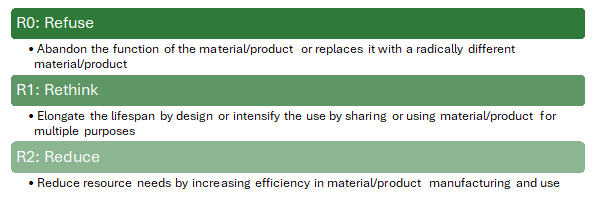
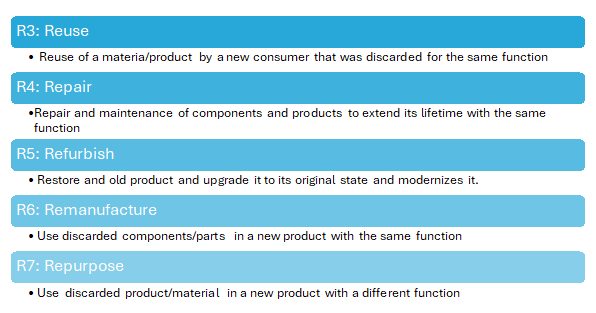
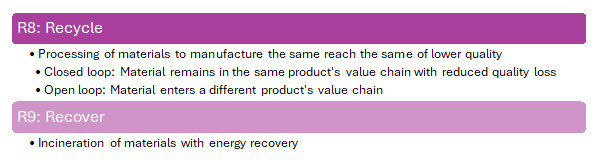
A logical step if we want to change this trajectory, is moving towards a circular economy. You have probably heard about the famous 3Rs: Reduce, Reuse, Recycle. In circular economy research, we now commonly distinguish between 10 different Rs, ordered from higher to lower circularity. They can be further grouped into different material cycles: narrow cycles, slow cycles and close cycles. They are summarized in the infographic below (Wiedenhofer et al. 2025; Potting et al. 2017):
Narrow: Reduce resource use and improve resource efficiency
Slow: Extend product and component lifetime
Close: Increase recycling
What does CO2nstruct has to do with Circular economy?
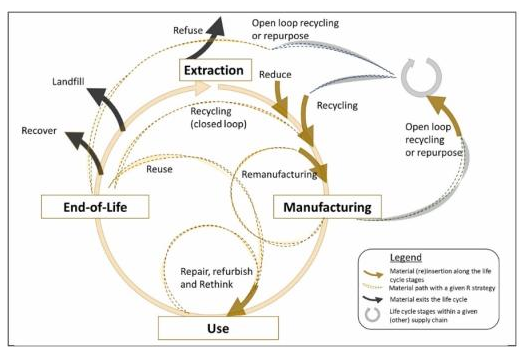
The Co2nstruct project aims to integrate these CE strategies into climate mitigation models and analyses the current state and future potential of using different R strategies to reduce environmental impacts of construction materials. Common practices for the different materials in the construction industry and offshore wind are summarized here:
Key References
Lima, Ana T., Gunvor M. Kirkelund, Zheng Lu, et al. 2024. ‘Mapping Circular Economy Practices for Steel, Cement, Glass, Brick, Insulation, and Wood – A Review for Climate Mitigation Modeling’. Renewable and Sustainable Energy Reviews 202 (September): 114697. https://doi.org/10.1016/j.rser.2024.114697.
Potting, José, M. P. Hekkert, E. Worrell, and Aldert Hanemaaijer. 2017. Circular Economy: Measuring Innovation in the Product Chain. Planbureau voor de Leefomgeving No. 2544. PBL Publishers. http://www.pbl.nl/sites/default/files/cms/publicaties/pbl-2016-circular-economy-measuring-innovation-in-product-chains-2544.pdf.
Wiedenhofer, Dominik, Hanspeter Wieland, Sina Leipold, et al. 2025. ‘The Circular Economy and Climate Change: The State of National and Global Evidence on Mitigation Potential’. Annual Review of Environment and Resources 50: 563–92. https://doi.org/10.1146/annurev-environ-111523-102441.