CE & Energy Models
This is a summary of the content of the paper “Gaps and Missing Links Between Circular Economy and Energy Models for the Construction Industry”, by Husam Sameer et al.
Link to full paper: https://doi.org/10.1007/s42824-026-00238-4
Bridging the Gap Between Circular Economy and Energy Models in Construction
Energy models are important tools used to understand how we produce and use energy, and to plan the transition towards climate neutrality. In the construction sector, they help estimate energy use, emissions, resource use and the effects of new technologies. However, a new study shows that most existing models do not fully consider how materials themselves can be reused, recycled, or kept in circulation.
Limited consideration of recycling steel and wood
The research reviews a range of widely used energy models and finds that they mainly focus on energy flows—such as fuel use and emissions—while largely overlooking material flows and circular economy practices. Most models only include recycling, particularly for steel, and rarely account for other circular economy strategies such as reuse, repair, or remanufacturing.
The study highlights that some materials, such as steel and wood, are better represented in models because recycling systems already exist. In contrast, materials like bricks and insulation are rarely included due to limited data and fewer established recovery systems.
Gaps and potential links to JRC-EU-TIMES (JET)
Buildings and construction materials play a major role in both energy use and resource consumption, yet current models often treat them as part of a linear system. As a result, they risk underestimating the potential for reducing emissions through more circular actions.
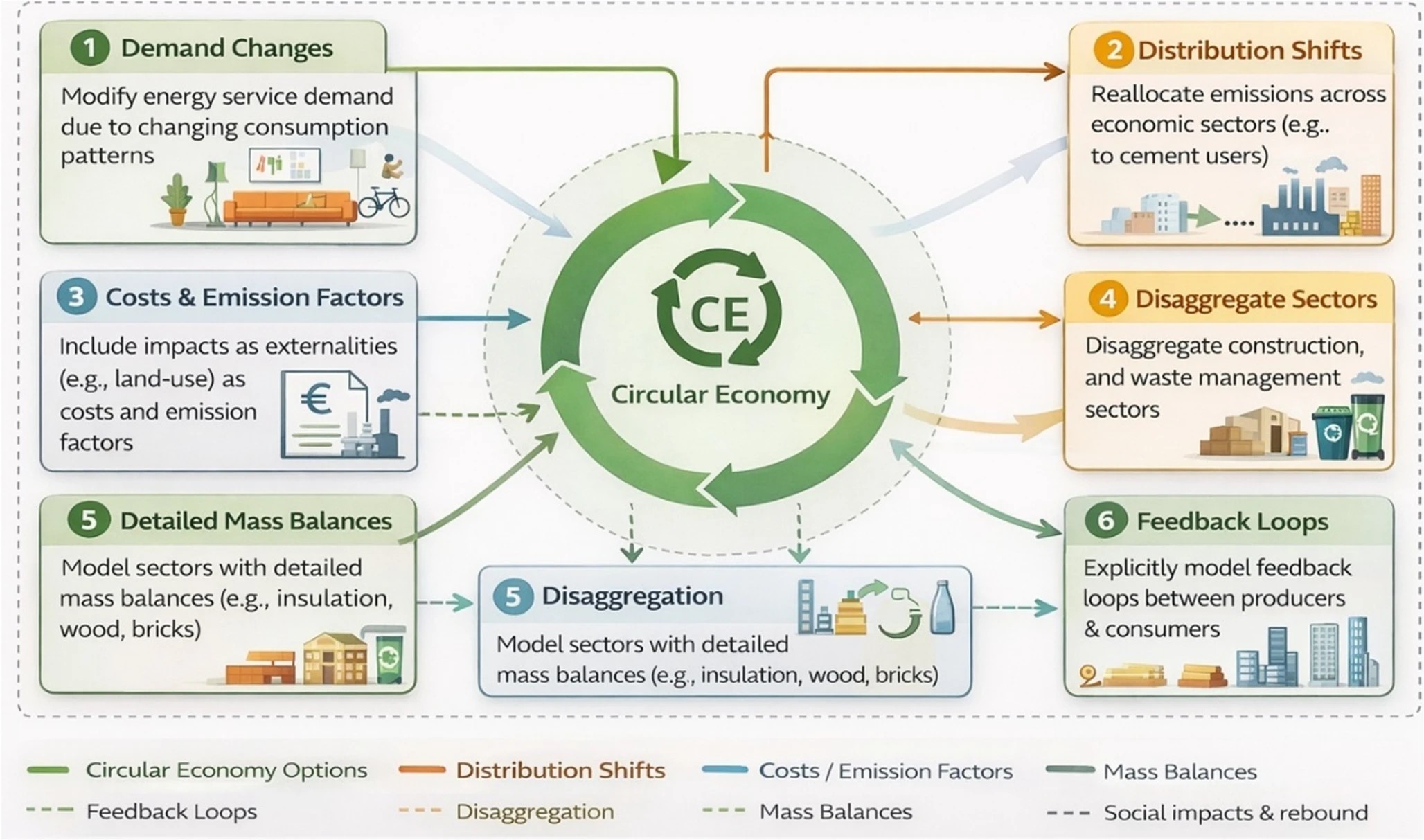
To address these challenges, the research explores how circular economy principles can be better integrated into energy models. Using the JRC-EU-TIMES (JET) model as an example, it shows that improvements can be made in two ways: by adjusting demand (e.g. reducing the need for new buildings through shared use), and by introducing new circular technologies and material flows into the model.